
Tiger reserves in India shelter ~75% of the World’s remaining wild tigers. Even then, despite several visits to the Tiger reserves in South India, I have not had a good, clean sighting of the elusive tiger. But as the say, “this too shall pass” and it did on a grand scale, on Day 1 of my visit to Tadoba Andhari Tiger Reserve in the month of March. The weather was dry, warm and dusty but it hardly mattered as I sighted a total of 4 adult tigers. One of them was close enough for a handshake while another was like watching a live show from row 10. Over 2 days, I sighted 5 adult and 2 sub-adult tigers.
Tadoba-Andhari Tiger Reserve is more popularly known as Tadoba National Park or simply Tadoba.
Where is Tadoba-Andhari Tiger Reserve?
Located in the State of Maharashtra, Tadoba National Park is 100+ kms from Nagpur, the nearest airport. My taxi took ~2.5 hours to reach Vanya Villas Resort located near Kolara gate, excluding the time spent on lunch break.
The road from Nagpur was generally good. The drive is not that scenic until I got closer to the National Park. Cotton is a key crop that is grown around Tadoba. There were no decent restaurants on the way. I stopped at a restaurant called Gravity just outside Nagpur where the food was ok but due to LPG shortage, it took an hour to cook food!
When to visit Tadoba?
My guide insisted that for tiger sightings, April and May are the best months, followed by March. The rains arrive in June and the core zone within the National Park is shut from July to September. I visited in March and my group as well as few others I met at Vanya Villas Resort had tiger sightings. But it does get quite warm and dusty, especially during the afternoon safari.
There are over 100 tigers in the core and buffer zones of Tadoba National Park. If one is not particular about tiger sightings, the winter months of November to February would be a better time.


Where to stay?
Tadoba National Park is spread over a large area and there are 22 safari entry gates all round. Where you stay will depend entirely on your safari bookings. There are few hotel/resort options near each of the core zone gates. Since getting a safari slot for the core zone is more difficult than getting hotel accommodation, I booked the safari slots first and then the accommodation at WelcomHeritage Vanya Villas Resort & Spa.
Ideal location would be near Kolara gate on the east side This will give one greater flexibility to visit Navegaon core gate in the North or Pangdi core gate in the South. The other good option is to stay near Khutwanda/Moharli gates on the west side. But from here, the other core gates are a bit far and may not be worth travelling to. Final option is to stay near Navegaon gate from where only Kolara core gate would be close enough.
WelcomHeritage Vanya Vilas by ITC
This is a nice Resort located very close to the Kolara gate. It is a bit rundown and not exactly luxurious but quite comfortable and well furnished. I paid INR 56k for a studio cottage for 3 nights on double occupancy, inclusive of breakfast.
Food was quite good but the buffet was a tad expensive for the available vegetarian spread at INR 1.6k for lunch and INR 2k for dinner, per adult. I think it will work out if you take an inclusive package or if you eat non vegetarian stuff. For vegetarians in my 9 member group, Ala Carte worked out to be far cheaper, at ~INR 500-700 per person. A shop near the reception was selling few very attractive apparel, accessories and souvenirs.
Breakfast/snacks/beverages for the safari are neatly packed and handed over before departure. I only had to place the order the previous day. Additional payment is required if not included in your package.
Safari bookings
Reserve Safari as soon as bookings open
The rush of visitors is unbelievable. Safari bookings open 120 days prior but most safari slots for the core gates are sold out in no time. There is a Tatkal option available 3 days prior but that is likely a viable option only if you live close by.
Vehicles are allotted once the group reaches the gate and IDs are checked. The Safari jeeps carry 6 visitors plus the guide and driver. There is no minimum occupancy requirement.
There are designated restrooms/eating areas inside both the core and buffer zones.
Deciding on the entry gates and timing
Tadoba’s core zone is served by 6 entry gates while the buffer zone has 16 entry gates. The official website states that the chances of spotting a tiger are the highest in Kolara, Navegaon and Moharli core sub-zones(Kolara, Navegaon, Khutwanda and Moharli core gates). But I sighted 2 tigers after entering through Pangdi gate. So how should you choose? There is no correct answer but given my experience, it is good to explore both the northern part and the southern part of the National Park as well as buffer zone for variety.
Choose core gates that are not very far from one another. From my resort, Kolara gate was a few minutes away but Pangdi took one hour and Navegaon 45 minutes. Ideally, book 3-4 safaris at the minimum. Having gone all the way, this will maximize your chances of spotting tigers.
Timings
There are 3 entry options – Morning at 6 am, afternoon at 2 am and full day(timings can vary by season). The morning and evening safari lasts ~4 hours. Even if you are a bit late, the jeeps would normally wait. Full day can be ruled out for general safari given the steep price.
Afternoon safaris are best for the entry gates requiring more travel time.
Core vs Buffer zone
The core zone is spread over 625 sq. kms while the surrounding buffer zone is spread over 1,100 sq. kms. The core zone has denser forest, established tiger territories and is a protected area. What may not be obvious is that there can be wildlife sightings, including tigers, even in the buffer zone. After all, for the wild animals, it is just one forest. In the summer months especially, there is high likelihood of spotting wildlife near the water bodies in the buffer zone. There are several villages in the buffer zone and the number of jeeps in the buffer zone average 4-6 as compared to 15-16 in the core zone. That means the buffer zone is far more peaceful.
I chose one buffer zone and 3 core zones.
My experiences
I chose the following gates:
Day 1 – Navegaon – core(morning), Pangdi – core(afternoon)
Day 2 – Kolara –buffer(morning) and core(afternoon).
At all the entry gates, 2 glass bottles of drinking water were provided. Mobile phones are not allowed to be used inside the Reserve and my guides deposited them in a box placed in the jeep.
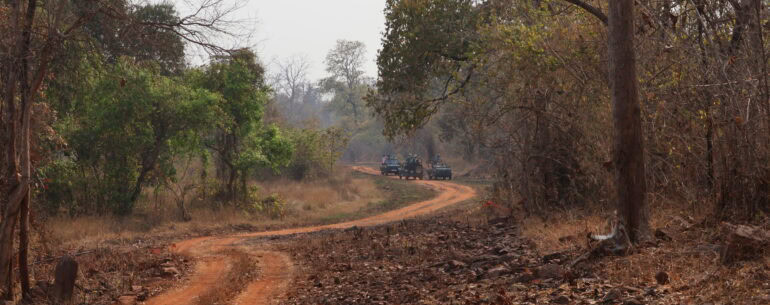
Once inside, the jeeps need not follow a rigid route. They do tend to congregate at places where tigers are sighted.


Navegaon(morning)
My best sightings were in Navegaon and Pangdi on Day 1. On the very first morning at Navegaon, soon after entry, I had a not too distant view of 2 tigers on 2 separate occasions before they disappeared behind the thick bushes. Check out the photos below and you will understand why it is so difficult to spot a tiger hiding behind dry bushes. I was happy I had finally seen an adult tiger, even if briefly. What I did not know was that the best part was yet to come.


Just after breakfast, while my jeep was on its way towards the exit, my guide learnt of a tiger movement on the road next to Tadoba Lake and quickly took a detour. And what a sighting that was! Roma, the tigress, was walking nonchalantly on the road, totally oblivious of the jeeps and its super excited occupants parked on the side. It walked past my jeep, so close that I could have extended my arm and touched the tigress. How did I feel? Hard to say….possibly a mixture of awe and maybe slight trepidation. For almost 10 minutes, my world came to a standstill, so focused I was on the visual spectacle.


Pangdi(afternoon)
Afternoon safaris can be a wash out until it cools down. And that happens well after 4pm. Around 2.30 pm, we reached a spot where few jeeps were waiting. I gathered that a tiger was resting behind a thicket. Knowing that afternoon is a difficult time, my guide decided to wait. I could see the tiger occasionally flapping its tail but that was it. And we waited for about 2 hours and just when we were on the verge of moving away, the tiger got up, sauntered across the road and disappeared again. But I got a great view for that one minute the tiger took to cross the road.
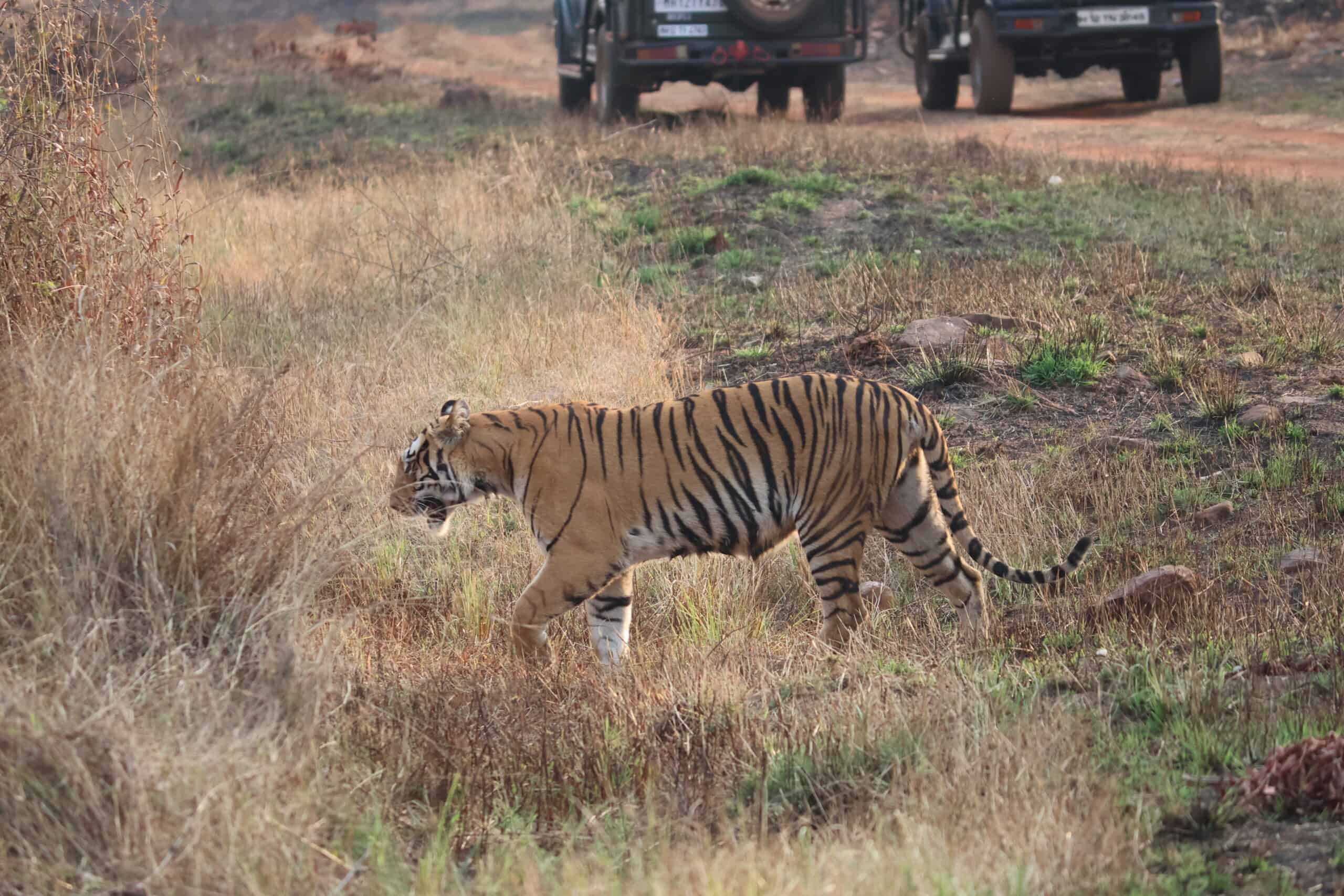
A private live show
What was to come was even better. My guide took to us a water body where we heard the call of a sambar as soon as we stopped. We waited with baited breaths and a few minutes later, a tiger emerged from behind the dense foliage, walked along the side of the water body, jumped in, swam a short distance and then walked away. Mine was the only jeep parked on the other side of the water body and I got to watch a private 10 minute live show!


As soon as the tiger went into the forest, I drove to a clearing nearby where it was expected to emerge. There was a bison peacefully eating grass and had not sensed the presence of a tiger. We waited for about 20 minutes but the tiger did not appear. The bison had sensed rightly! It was getting dark and I had no choice but to move away. Again the feelings in those moments are so hard to describe – middle of a forest, twilight, eerie silence punctuated by calls of birds, a bison nearby and we in a jeep tensely waiting with full involvement.
A very prolific day
What a day this was. It will be remain etched in my memory for a long time. By the way, I also sighted deer, sambhar, bison, several birds, a pair of wild dogs consuming a kill and some unique trees including crocodile tree and the white colored ghost tree.


Kolara(core and buffer)
Buffer(morning)
In the early morning, a tigress with 2-3 sub adults had been spotted eating a kill inside a thicket. One path from the thicket led to a water body and presuming the tigress will head to the water body after the meal, over 10 jeeps, including mine, parked in the clearing. But no luck. We then went round and I caught a brief glimpse of 2 sub adults walking in a direction exactly opposite of the clearing where the jeeps were waiting! Logical thinking cannot predict a tiger’s movements!
One very interesting bird that I saw is known as Indian Nightjar. During the day, it sleeps on the ground and after dark, it hunts for insects. It is extraordinarily well camouflaged and almost impossible to spot.


Core(afternoon)
In the core zone towards the evening, I spotted a herd of bisons resting, a couple of wild dogs on the road side and then a black sloth bear in a clearing. The sloth bear looked at our jeep and for a few seconds, was possibly contemplating next steps before deciding to move back into the bushes. We fell silent and I also decided not to disturb the bear by clicking pictures. After a few minutes, the sloth bear appeared to be stepping out into the clearing before the sound of another approaching jeep made it run away for good. A bit later, spotted a tiger resting near a lake. But it was way too far though clearly visible through the binoculars that my guide was carrying.
Other than that, few peacocks/penhen and other birds, besides deer/antelope made up the day.
There are no elephants in Tadoba and I did not sight any leopard or wild buffalo.


Safari Cost
The all inclusive fee comprises guide fee, entry fee and jeep/safari fee. I paid INR 7k for Kolara buffer, INR 12.8k for Kolara core, INR 8.8 k for Navegaon and Pangdi core. A total of INR 37,400 that included one Saturday. While costs are lower for bookings done within 60 days, it will be hard to get a slot in the core zone(especially the popular ones) during the peak season. Buffer zones may be available though. Weekends cost more and buffer zones are cheaper. Only Navegaon collected additional camera fee of INR 295.
Cancellations are possible but only if you cancel clear 60 days ahead of time, you get 100% refund.
I was initially inclined to opt for a full day safari but baulked at the cost – INR 50k. It did not make any sense and eventually booked separate morning and afternoon safaris.
What is good at Tadoba National Park
There are designated stopover points with newly built toilets, running water supply, benches/tables for eating and even provision for drinking water. There are toilets at entry gates also.
It was fun having breakfast inside the forest. My Resort had thoughtfully packed a bit of extra food that I could share with the guide and the driver. One break is definitely required as the safari lasts 4 hours.
There are several water bodies, some natural and some man made. This increases the probability of sightings, especially during the summer. Guides were clearly focused on tiger sightings and did not dwell much on other animals, local trees, birds etc. Unless queried specifically.
What I did not like at Tadoba National Park
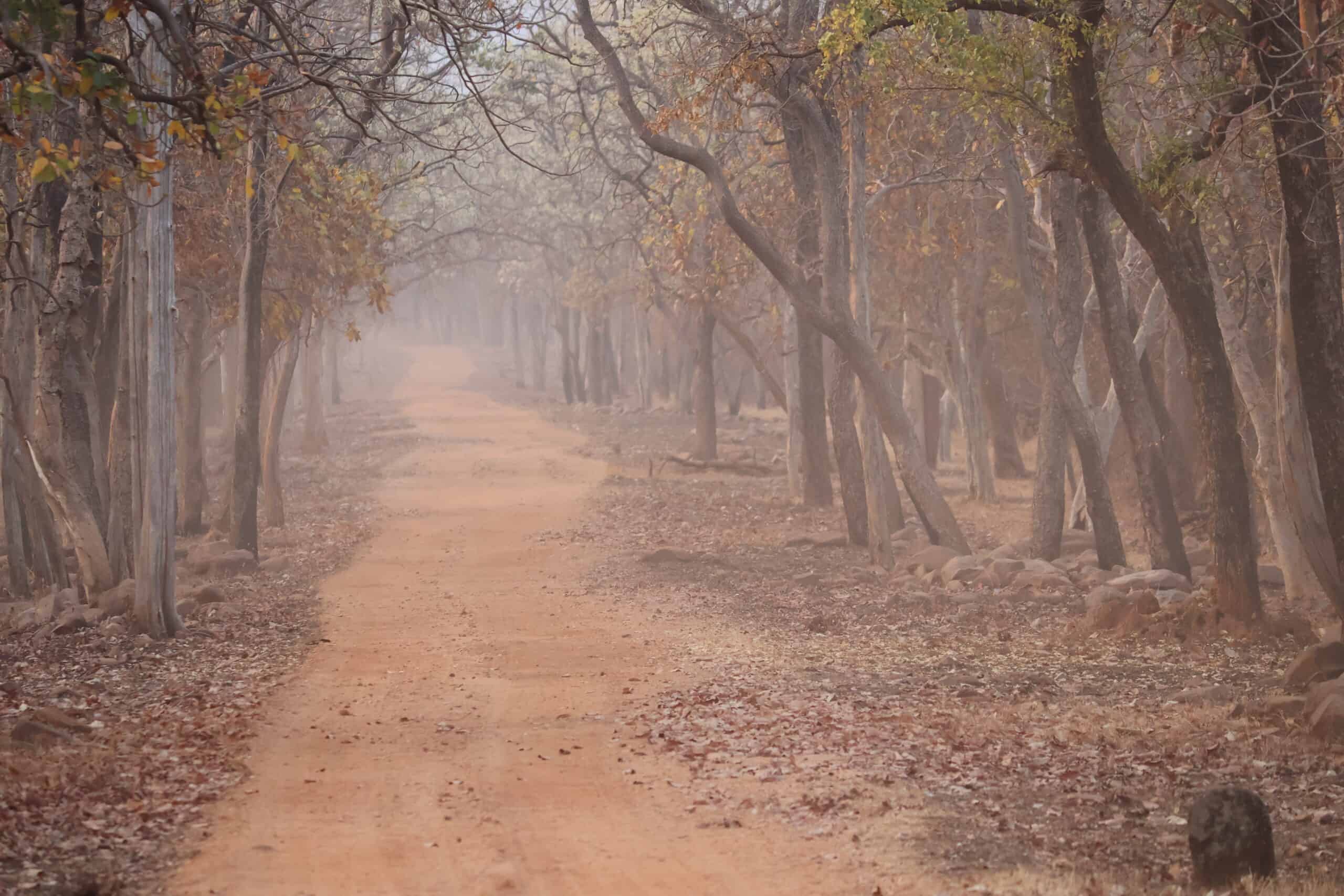
The safari drives were very dusty, kind of red dust. The jeeps were covered with layers of dust though the seats appeared to have been wiped. Gets worse when vehicles pass and when following behind another vehicle. The dust in the air tended to settle on my clothes, shoes and the camera. I had to cover the head and the face especially when the jeep was in motion. How I wish I could do away with the camera and just enjoy the visuals without worrying about the dust!
Several jeeps congregate wherever a tiger is sighted. No problem with that but when Roma, the tigress was sighted, the jeeps created a ruckus with constant forward and reverse motions to get into a vantage position. It was just as well that she did not appear to be perturbed. But what if that was not the case? I still vividly recollect my jeep being attacked and chased by a disturbed wild buffalo at Masai Mara, Kenya, even though 7 years have passed. Luckily, only the jeep suffered a big dent.
Local Transport
I hired a car in Nagpur and retained it till return to Nagpur airport. My Resort, Vanya Villas had dormitory accommodation for drivers at INR 400 per night(INR 1k per night with food). They also provided pick up and drop facility – INR 700 for Kolara, INR 2k for Navegaon and INR 2.5 for Pangdi. Nagpur pick and drop was more expensive but it is a fall back option.
Should you visit Tadoba?
Watching wild animals in their natural habitat is always exciting but that is obviously not the only reason I keep returning to wildlife sanctuaries. I have learnt two lessons over the last many years – one, summer time is the best time for tiger sightings, just prepare for the heat and dust. Second, opt for 3-4 safaris at the minimum. Compared to the safaris at Bandipur/Nagarahole in Southern India, the safaris at Tadoba last much longer at 4 hours, thereby increasing the probability of sightings.
While Tadoba does report more successful tiger sightings, they are by means ‘guaranteed’. Even then, it is worth a visit in the summer months.
For more information
https://mytadoba.mahaforest.gov.in
Related posts
Discover more from My Travel Innings
Subscribe to get the latest posts sent to your email.